

Configuring data visibility and functional access in modern enterprise Cloud systems is rarely trivial. In Oracle Fusion HCM Cloud, achieving granular control requires deep understanding of how security layers interact. When your security architecture mandates restricting an HR administrator’s view by specific structural elements—such as department boundaries or legal entities—relying exclusively on static definitions falls short. This article breaks down the layered Oracle HCM security framework and details how to design, build, and auto-provision context-aware security schemas using Areas of Responsibility (AOR).
The Four Layers of Oracle HCM Security Architecture
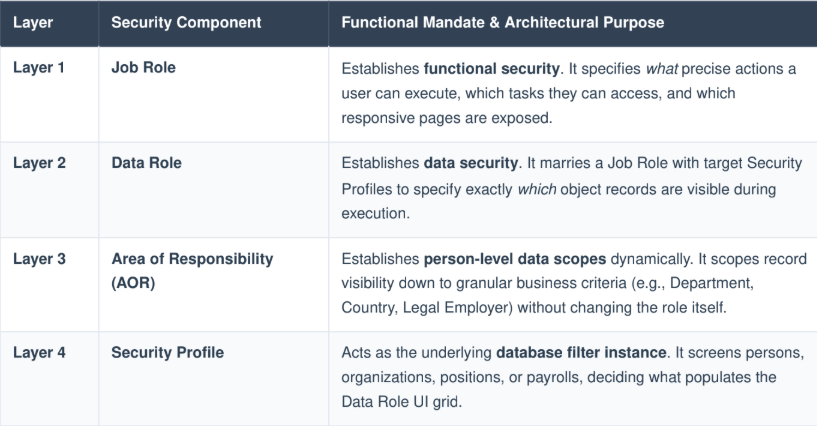
Oracle Fusion HCM Cloud delivers security through a layered, contextual framework. Understanding the specific boundary of each layer prevents compliance gaps and role inflation:
PREREQUISITE SEQUENCING RULE
To ensure a completely clean implementation, your configuration sequence must follow this exact linear
order:
- Construct or clone the underlying Job Role.
- Construct the overarching Data Role.
- Inject and bind AOR Scopes within the Data Role or individual Security Profiles.
- Provision the configured role to the end-users.
Scaling with Areas of Responsibility (AOR)
Instead of maintaining dozens of specific data roles for every regional office or department block, Areas of Responsibility allow you to externalize data boundaries directly to the employee’s assignment profile.
Create the systemic filter that parses AOR assignments at runtime:
- Go to Workforce Structures > Tasks > Manage Person Security Profile. Click Create.
- In the Area of Responsibility block, check the box for “Secure by area of responsibility”.
- Specify the target Responsibility Type (e.g., Human Resources Representative). This acts as the key that links this profile to the worker’s data.
- Declare the definitive Scope of Responsibility. Options include:
- Department: Restricts data strictly to workers in the assigned department (and its child organizations if using hierarchies).
- Country: Maps data boundaries to the country where the Legal Employer is officially registered. It does not look at the employee’s physical workspace location.
- Legal Employer / Business Unit: Restricts visibility to those explicit corporate structures.
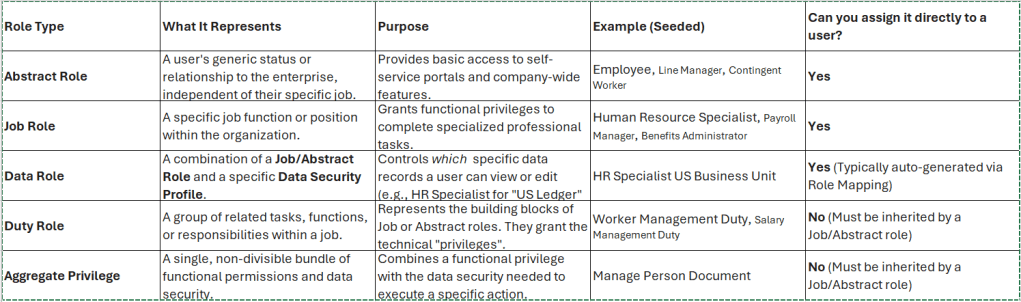
Comparison of Roles in Oracle Fusion HCM
Here is a comprehensive breakdown of the different types of roles in Oracle Fusion HCM, organized into a clear comparison table.
 Fusion People Hub
Share your Feedback